| Ch 8. Rigid Body Momentum/Impulse | Multimedia Engineering Dynamics | ||||||
| Impulse Momentum | Eccentric Impact | ||||||
| Eccentric Impact of Rigid Bodies | Case Intro | Theory | Case Solution | Example |
| Chapter |
| - Particle - |
| 1. General Motion |
| 2. Force & Accel. |
| 3. Energy |
| 4. Momentum |
| - Rigid Body - |
| 5. General Motion |
| 6. Force & Accel. |
| 7. Energy |
| 8. Momentum |
| 9. 3-D Motion |
| 10. Vibrations |
| Appendix |
| Basic Math |
| Units |
| Basic Dynamics Eqs |
| Sections |
| eBooks |
| Dynamics |
| Fluids |
| Math |
| Mechanics |
| Statics |
| Thermodynamics |
©Kurt Gramoll
|
|
|
||
 Rod Impact |
Example |
|
|
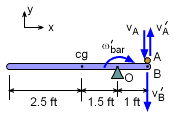
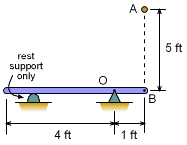
A slender bar, B, has a mass of 2 slugs and is pinned at O. A 2 slug particle, A, is dropped from a height of 5 ft and strikes the bar at the far right end. What is the angular velocity of the bar just after impact? Assume the coefficient of restitution, e, is 1. |
||
| Solution |
||
|
|
First, find the velocity of the particle just before it strikes the bar. From conservation of energy, However, the linear velocity of B is related to the angular velocity of the bar, Combining gives, The angular momentum of the bar (with the particle attached) must be conserved, giving,
Mass moment of inertia, Io ω'B = 6.729 rad/s |
|
| Example Problem 1 |
||
|
||
| Example Problem 2 |
||
|
||
| Example Problem 3 |
||
|
||
| Example Problem 4 |
||
|
||
| Example Problem 5 |
||
|
||
| Example Problem 6 |
||
|
||
| Example Problem 7 |
||
|
||
| Example Problem 8 |
||
|
||
| Example Problem 9 |
||
|
||
| Example Problem 10 |
||
|
||
| Example Problem 11 |
||
|
||
| Example Problem 12 |
||
|
||
| Example Problem 13 |
||
|
||
| Example Problem 14 |
||
|
||
| Example Problem 15 |
||
|
||
| Example Problem 16 |
||
|
||
| Example Problem 17 |
||
|
||
| Example Problem 18 |
||
|
||